Search This Blog

Saturday, April 30, 2011

Some Chinese Philosophy Or Another Translation Example: Some Do’s And Don’ts.

     
I received the following Chinese “poem” from a friend; a piece on human behaviour about how people act in general according to their current financial state of affairs. Certainly I am no expert in ascertaining how true it is in applying to the general populace. I am more interested in the translation to English. As a perfectionist, I was aghast at its poor quality as I read the original translation even though any English reader can grasp the soul of the poem easily. It was simple enough an example to show how one can do a better job in translation. My translated version is in italics. For more information see my essay on the “The Barbaric Goddess.”


http://jeffinous.blogspot.com/2010/10/barbaric-goddess-or-finer-points-in.html

沒錢的時候, 養豬;
When without money, keep pigs;
When poor1, raise a pig;
Being Rich

有錢的時候, 養狗.
When have money, keep dogs. 
When rich1, keep2 a dog.

沒錢的時候,在家裡吃野菜;
When without money, eat wild vege at home;
When poor, eat veggies3 at home;

有錢的時候,在酒店吃野菜.
When have money eat same wild vege in fine restaurant.
When rich, eat veggies at restaurants4.

沒錢的時候,在馬路上騎自行車;
When without money, ride bicycle;
When poor, ride a bike5 to work6,

有錢的時候,在客廳裡騎自行車.
When have money, ride exercise machine.
When rich, ride an exercise7 bike in the guest room.

沒錢的時候,想結婚;

Being Poor

When without money wish to get married;
When poor, yearns8 for marriage;

有錢的時候,想離婚.
When have money, wish to get divorced.
When rich, wished9 for divorce.

沒錢的時候,老婆兼秘書;
When without money wife becomes secretary;
When poor, wife10 IS the secretary;

有錢的時候,秘書兼老婆.
When have money secretary becomes wife.
When rich, secretary10 IS the wife.

沒錢的時候,假裝有錢;
When without money, act like rich man;
When poor, act11 like the rich;

有錢的時候,假裝沒錢.
When with money, act like poor man.
When rich, masquerade11 like the poor.

人 啊,都不講實話:
Man oh man never tells the truth:
Man O man, never can he tell the truth12:

說股票是毒品,都在玩;
Says share market is bad but keeps speculating;
Stocks and bonds are drugs, but still we keep on Tango-ing13;

說金錢是罪惡,都在撈.
Says money is evil but keeps accumulating.
Money is evil, we still keep on gaining14.

說美女是禍水,都想要;
Says women are trouble-makers but keeps desiring them;
Beauties15 are trouble yet desiring them to no end;

說高處不勝寒,都在爬.
Says high positions are lonely but keeps wanting them.
Lofty posts though lonely yet we hunger16 for them.

說煙酒傷身體,就不戒;
Says smoking & drinking is bad but keeps partaking;
Smoking & drinking: filthy habits we can never forgo17.

說天堂最美好,都不去!!!
Says Heaven is good but refused to go!!!
Paradise18 is most wonderful yet we refused to go!!!

鄉下早晨雞叫人,
In the rural areas, chicken calls man awake.
In villages, in the morning the chicken19 calls the man.

城裡晚上人叫雞;
In the cities, man calls for chickens.
In cities, in the night the man calls for chickens20.

舊社會戲子賣藝不賣身;
In the past, famous actresses will not sell their bodies;
In the past, divas21 sell their talents not their bodies;

新社會演員賣身不賣藝.
Now actresses will sell their bodies to become famous.
Nowadays, they22 sell sex but not their talents.

-----------------------------------------------------------

人生是什麼?

What is life about?
What is life?


1 歲時出場亮相
At one, YOU are the top priority
At age one, you are the STAR23.

10 歲時功課至上
At ten, academic excellence is the top priority.
At age ten, academic excellence is THE top priority24.
20 歲時春心盪漾
At twenty, getting dates is the top priority
At age twenty, spring desires takes control23.

30 歲時職場對抗
At thirty, a good career is top priority
At age thirty career is the main battle25.
40 歲時身材發胖
At forty, keeping your body in shape is top priority.
At age forty, one's waistline keeps on expanding.

50 歲時打打麻將
At fifty, beating others at mahjong is top priority
At age fifty, time often spent on playing mahjong

60 歲時老當益壯
At sixty, keeping IT up is top priority
At age sixty, keep IT up is top priority26

70 歲時常常健忘
At seventy, remembering something is top priority
At age seventy, able to remember is a good thing.
80 歲時搖搖晃晃
At eighty, moving around is top priority
At age eighty one needs to move around more often27

90 歲時迷失方向
At ninety, knowing directions is top priority
At age ninety, getting lost is often the case.

100 歲時掛在牆上
At 100, having your portrait on the wall is top priority!
At age hundred, having your wall portrait27 is top priority!

祝大家愉快,好好做人!
Wishing you all happiness! Be good!
Wishing all happiness abound and be a good person in life!

NOTES:

29 Apr 2011

1. The original translation sounds too much like broken English. Retaining the original flavour of the poem does not give any added value. The original text uses the same word twice and I find it boring in the English version. So I try to use as many different substitution words but still in keeping with the intent of the poem.

2. “Keep” has the connotation of choice while “raise” has a sense of compulsory obligation or duty.

3. The original words used were indeed “wild vegetables”. It is fine in Chinese but to an English reader, it sounds odd since vegetables are grown by man and cannot be wild.

4. In the original text, there is no adjective used to describe the kind of restaurant one is eating at. Such exaggeration is unneeded as it does not improve much. By eating out already infers that one has enough money to do so. However the word, "same [kind of] " may be added for emphasis. See also Note 7.

5. Earlier on, the original translator used “veggie” (even though spelt wrongly) as slang for vegetable in view of the lightness in tone of the poem, such usage should be inconsistent throughout in the poem.

6. In the original text, it meant, "ride a bike on the road".  I did not translate, "on the road" because the meaning is implied under ordinary circumstances.  One cannot ride a bike on water!  Instead, I chose the phrase, “to work” in to contrast it with the next line. “To work” suggests a task must be done.
7. The word “exercise” does not appear in the original text. However in this case the original translator correctly added this extraneous information to convey a clearer meaning to readers.

8. Same reasons for notes 2 and 6.

9. In the original text, the character used can also mean “to think”. Both of us chose “wish” because with community property laws getting a divorce is difficult or impossible to do so.

10. By using appropriate capitalizations a piece can comes to life.

11. Again the original text uses the same character twice meaning “to pretend.” I like the original translator choice of the word “act” as its smacks with hints of pretence; much better than my first choice “pretending”.

12. Just a matter of style preference. “Ah, man can never tell the truth” doesn’t sound poetic enough for my personal taste.

13. The original character used is “to play” as in “playing the stock market”. I like the original translator’s choice of “speculation” because “play” has hints of something we usually do for fun. However in the rest of the line, we take on different sides in contrast to note 11. The original translator uses an inference while I took on a more literal translation. Retaining the original flavour of the poem works better in paint a more vivid picture. In doing so, I cannot use the verb “speculate” anymore.

14. The character used means “to scoop”, but in Cantonese slang it means “make money” or “to work” rather than to accumulate. “Gain” is a better choice as its meaning is closer in spirit even though “accumulate” also reflects the intent of the poem to the reader.

15. The original text uses, “beautiful women”. Here I don’t understand why the original translator drops the word “beautiful”. Beautiful women don’t need to not make trouble. They are trouble themselves! This is also reflected in the original text. Therefore I feel the original translation is wrong in this respect. At the same time in keeping with tone of previous lines, the slang word, "babes" should be used. I prefer “beauties” because to a gay man, women beautiful or not will not be as desirable as they are for a straight guy. The word “beauty” certainly applies to the imagination of whatever inclination the reader is oriented towards. “Desire” is a more powerful emotion than just “want”. The word, “Says” has been dropped because I find it redundant. It is assumed that someone is expounding the truth of the poem to us while we are reading it. At the same time, I have added, “to no end” for better reading in the target language.

16. The literal meaning of this line is, “High positions are cold yet we still want to climb.” We both came to the same conclusion that literal translation does not work well in this instance. However we chose to express it differently. Again “hunger” is a stronger emotion than “want”. At this time, I elicited in changing the line structures so as not to make the repetition too boring for the reader.

17. The literal meaning of this line is “Smoking and drinking are harmful to our bodies yet we don’t want to kick these bad habits.” I like his choice, “to partake” although “to forgo” is a little truer to the intent of the line. At this stage, the repetitive nature of the poem becomes stale and change is definitely needed to break the monotony.

18. Since Cantonese slang was used in the poem, the word “Paradise” is the better word choice than “heaven” in translating “Hall of Heaven”.

19. Technically “chicken” is the wrong word to use. Chickens don’t crow, roosters do! Chinese unlike English do not have different words to differentiate the sex of chickens. An exception is made in this instance because of the next line in the poem. In using the correct translation, “rooster wakes the man”, the play on words in the original language is lost.

20. Cantonese slang for calling the oldest profession. Streetwalkers are known as chickens but of course nowadays denote both sexes. For whatever reason the original translator had in mind, the word “night” is must be retained.

21. The original characters used meant actors, especially those performing in Chinese opera. However they can also mean movie actors/stars although nowadays the more common term (literal translation from English – “bright stars”) is used for the distinction. I like the original translation of “in the past” for “old societies” and “now” for “new societies”.

22. The original characters used meant performers in general. I chose the word, “them” to emphasize those in the same profession.

23.  Although the original translation is correct, it had lost the flavour of the original text.  Never infer too much when a literal translation is sufficiently clear and makes the reader come to the same conclusion.

24.  Except for minor changes, we are in total agreement.

25.  There is nothing in the original text to suggest about the quality of the career.

26.  The literal meaning is "health is the top priority" at this stage of the game.  However such exaggerated inference gives the piece much liveliness and humour and does not diminish whatever the intent the author was trying to infer.  This is an example of good translation that takes the soul of the text into the consideration.

27. It could also mean one is getting to waver and tottering clumsily. But with the context, this may not be the case.


28. Having a good portrait in preparation for one's funeral. No one wants to look like a dead thing even on his own funeral! Such is the vanity of human nature.

Wednesday, April 27, 2011

Number One Scholar - Chapter 2 - A Distinguished Future Must Be In Store For Ah Chui

  
Copyright © 2011 - Jeff Loh. All rights reserved

Chapter 2 – A Distinguished Future Must Be In Store For Ah Chui1.

Old Lun Eight2 on seeing the current situation knew that his old lady was going to explode any moment and he was getting very antsy.

“Old Eight, let me look after Eighth sister-in-law3. You better go and find a midwife quick!” Night Watcher Six advised.

Old Lun Eight thought to himself,

“Surely you jest! If she explodes right now, won’t you have an eyeful of everything? Sheesh!”

Therefore to Night Watcher Six, he pleaded,

“Sixth younger brother4, if you really want to help, you must send Buddha to the West5. Mind if I trouble you going next door and bang on the door to wake up Bagasse Fifth Aunt6 and then to the opposite corner and call the wife of Ah Chan, the pickled vegetable seller, to come. They had promised help when the moment arrived.”

With those words, Night Watcher Six immediately went a-calling. Not long afterwards Bagasse Fifth Aunt and Mrs. Chan came groggily and asked Eighth Uncle,

“Any movement yet?”

“I don’t have any movement but my wife has!” retorted an antsy Eighth Uncle.

Quickly everyone went about their assigned tasks; to heat some water, to carry and assist Mrs. Eighth. Night Watcher Six went back to his rounds. For a while everyone hustled and bustled. Finally the baby came crying “wah wah” into this world alerting the entire three streets of the neighbourhood. Bagasse Firth Aunt announced as she carried the baby,

“Congratulations to you Eighth Uncle, you got yourself an arrowhead stalk7!”

On hearing the congratulatory words, Eighth Uncle quickly went forth to take a look and was overjoyed upon verification. But then on a second look, he saw the baby had very odd features, a head big as a bucket with little sparkly eyes. The strangest of all was that his entire body covered with marks that looked like fish scales. However the body is strong and healthy. After Bagasse Fifth Aunt finished washing the baby, she wrapped him in a blanket before presenting to Eighth Aunt. When mother gazed upon her son, she gave a big fright and from of her mouth she out came an “Ai yah!”

Eighth Uncle asked what the matter was. Eighth Aunt stuttered,

“Strange, very strange indeed! This baby looks like that thing I was dreaming earlier. I wondered if this omen is good or bad.”

Eighth Uncle consoled her and gave this baby the name of Lun Mun Chui8. When one has something to say, the day is long, and days are short when there is nothing to say. Time passed quickly and Ah Chui was now five years old. Because he was often sickly as a baby, his body size was unusually skinny and diminutive. However his head was especially large in proportion to his body. Eighth Uncle had often heard the adage, ‘A large head is for the great and big-footed is but a beggar’. Looking at his son’s unusual features of a large head and a small body he would recall the strange circumstances in which his son was born. In the end the father was very sure that his son would amount to something great in the future. Because of this reasoning, he was not disheartened. Not only was he not disheartened, he was extremely sure that his son would become an official someday. Of course in order to become one, he would need schooling. Lun Old Eight is a vegetable seller, how could he make enough money to send his son to school? Before Ah Chui was born, the two old biddies barely eked out enough just to have skin on them. Now with an extra Chui, there is one more burden. No matter how one calculated, there was no way they could send their son to school.

Because of this Old Lun Eight worried day and night. Enduring here, struggling there, very soon he reported to his maker9! Poor Ah Chui, losing his father at such a tender age. Luckily for him, his mother had the will of an arrow’s flight and the determination to park the boat10 [she never remarried]. She hoped that her struggles would eventually be able to rear her son up.

How about Ah Chui? Of course he didn’t go to school at all. Everyday he would play with neighbour kids. The only good thing about him was that he was smart and intelligent. Anyone who saw him loved him except for the monks of the West Zen sect. They hated him to the core. Why, you ask? This is because Ah Chui lived at the west gate of “First Candidates Selection” which is not far away from the Temple of Bright Filial Piety. Each day Ah Chui with his gang of screaming imps would enter the West Zen sect temple to play…

Notes:

25 Apr 2011

Edited by the Jimbo.
1. The prefix Ah (亞 or 阿) is used inconsistently throughout the book. May be there were not enough blocks to go around for the print. This is diminutive naming to produce affection.

2. Another way of adding affection to Ah Chui’s father who was obviously the 8th son in the family.

3. A respectful term for addressing someone’s wife. The exact Chinese term used is wife of one’s younger brother so as not to offend her by implying that she is old (by using the term for one’s older brother’s wife).

4. Another respectful term while adding endearment. Lun’s father is asking for a favour from Night Watcher Six. At the same time, we can infer that Lun’s father is older. When strangers meet, one of the first things they do is to establish their age so that proper terms can be applied. Sometimes even when one is older, a younger term is used for oneself to ingratiate oneself to the other person.

5. Buddha came from the west (India). So therefore to send Buddha back to where he came from means that you really want to help out to the end.

6. Bagasse is the fibrous matter that remains after sugarcane stalks are crushed for juice extraction. The exact term used here is the wife of one’s father’s younger brother.

7. Arrowhead bulb, Sagittaria sagittifolia. It looks like the private parts of a baby or little boy. Hence Cantonese expression for baby boys. In the original text the character used for stem is 蒂 but in Cantonese 椗 is used instead. During Chinese New Year, especially in a young family, mothers-in-law usually present a pan of growing Arrowroot bulbs as a hint to the young wife to get a grandson for them soon!


8. I really doubt that this illiterate vegetable seller was able to choose such a grand name for the sun. See the Preface on the meaning of our hero’s name.

9. The Cantonese use the word “gourd” or “squash (the vegetable)” to mean death or to die. This is because both words share the same sound. However there is no ‘proper’ word for the word death and the gourd word is used. Therefore one does not serve such food on festive days or happy occasions in Cantonese families. Bitter gourd is the most dreaded dish to serve it sounded like ‘a bitter death’ – fu gua. Some people tried to rename it as 涼瓜leong gua - “cooling gourd” to have a connotation like the English slang “cool cucumber”. However the death-sounding homophone cannot be avoided. Here is an interesting or rather funny story from my Hong Kong friend Simon Hui,

His sister’s mother-in-law was a very superstitious woman. Ordering highly inauspiciously named dishes on special occasions such as her birthday was especially frowned upon and to be avoided at all costs. However her son-in-law loved to eat bitter gourd cooked with beef. He knew of her taboos and instead of ordering bitter gourd, he ordered “cool gourd” instead. The moment he uttered the words, one could see darkest clouds covering the old lady’s face and fire spewing out of her eyes. The stupid - or rather - the careless cavalier attitude of the son-in-law had committed an extreme faux pas. The word “cool” has the exact pronunciation as his mother-in-law’s surname, Leong (梁)! Therefore it meant “May she die on her birthday dinner” He should have abstained from ordering any gourd dishes in the first place.

10. This line came from a poem in one of the 24 stories of filial piety (二十四孝).

矢志柏舟守節貞 With the aim of an arrow in flight, the will to park the boat, I shall be chaste to my widowhood.
家貧紡織以維生 My family is poor and I shall weave (silk) to support them.
奉姑行孝傳遐邇 The fame of my respect and filial piety to my mother-in-law shall spread far and wide
彤管休揚千載名 Need no red brush to record my name.

During the Han Dynasty, a young wife of 16 promised her husband that in case he does not return from the war, she would take care of her mother-in-law and treat her as her own. After 3 years of mourning for her dead husband was over, her mother-in-law tried to force her into remarriage so that they could have a better life. She refused and would rather die than to break the vow to her husband. Her mother-in-law relented and the daughter-in-law continued her filial piety until the old lady died at the age of 80. When Emperor Han Wen Ti heard her tale, she was awarded with 40 pounds of gold and entitled her the name of “Lady of Filial Piety.” http://www.namoamitabha.net/ch/publication/filial_piety/24stories10.htm

The literall meaning of 彤管 is red brush. A ritual monthly gift (a pair) from Han Dynasty prime ministers. These brushes were used by female secretariats to record the comings and goings of the queens and imperial concubines of the Inner Palace where no uncastrated male is allowed.

Original Text
二 認定亞敘將來必貴

倫老八見此情形, 知道老婆將近爆槳,當堂手忙脚亂, 打更六說:

“老八等我同你看住八嫂先, 你去揾執媽嚟1可矣!”

倫老八個心諗; 揾笨2乎? 萬一真正爆起槳來, 豈不俾你睇3見晒4? 乃叫打更六曰

“六叔, 為人為到底, 送佛送到西, 多煩你同我去隔籬5拍門叫醒蔗渣五嬸, 再去斜對面嗌嗌賣鹹酸阿陳個老婆陳嫂來幫手, 事関佢地早已應承也.”

打更六一聽得, 連忙前去, 未幾, 蔗渣五嬸, 鹹酸陳嫂均已懵懵忪忪趕至, 問八叔,

“作動未?”

八叔話我就未作動, 我老婆就作動矣.”

於是大家夾手夾脚俾6個煲水,俾個扶住八嫂, 俾個執定架部, 打更六則仍然去打更, 大家忙了一陣, 蘇蝦仔7已告脫穎而出, 唔呀唔呀, 三條街都聽聞, 蔗渣五嬸抱起蘇蝦仔一睇, 當堂話:

“恭喜咯八叔, 生個茨菇蒂8!”

八叔聞言, 連忙上前, 睇下果然真係, 不禁大喜, 再睇下個仔, 生得形容十分古怪, 頭大如斗, 眼仔晶晶, 最奇怪者, 則全身一片片, 好似魚鱗噉9, 但身体却結實異常, 蔗渣五嬸同佢洗完身之後, 揾張被仔裏住, 就交俾八嫂, 八嫂一睇, 當堂大吃一驚, 哎喲一聲, 脫口已出, 八叔問乜事? 八嫂口震震噉話:

“奇嘞10做乜亞蘇仔, 十足同剛才我發夢所見個野一樣噉嘅11, 唔知是吉是兇也”

八叔仍安慰之, 就同此蘇蝦仔, 改個名叫做倫文敘, 正是有話日長, 無話日短, 不經不覺亞敍已經五歲, 因為亞敘自小病痛多, 所以奀12細異常, 不過亞敘身軀雖然奀細, 個頭則特別宏偉, 八叔聞得俗語有話,頭大君子, 脚大乞兒, 今見亞敘形狀, 頭部特大, 而且出世之時, 又是單咁古怪嘅野, 所以認定個仔將來, 必然有貴, 因此亦不恢心, 不特不恢心, 而且對亞敘希望甚大, 但希望還希望, 家無讀書子, 功名何處來, 想個仔將來做官, 當然非供書教學不可. 無奈倫老八向來家窮只靠賣菜度日, 在亞敘未出世之前, 両老, 亦僅僅有皮, 多了一個敘, 便多一個負担, 自然唔够算, 慢講供個仔讀書乎? 為此之故, 倫老八乃日夜担心, 捱埋捱埋有幾耐, 便宣告瓜! 可憐倫文敍, 自少喪父, 好在母親八嫂矢志柏舟, 希望捱大個仔, 於是便靠織布度日, 亞敘呢? 自然無書讀, 日日同坤群嬉戲, 好在佢聰明伶俐, 所以人見人愛, 但有一件事, 被西禪寺的和尚僧到入骨, 點解呢? 原來亞敘住在西门擢甲里, 此地距光孝寺甚近, 亞敘便日日同地一班嘩鬼, 入去西禪寺頑耍.

1. 來.

2. 揾笨 to be or treated a fool, to be tricked etc. 揾 is Cantonese for 找 or 尋.

3. 看.

4. All in 做晒–all done, 揾晒–find everywhere, 見晒 - seen all.

5. Next door i.e. separated by a fence.

6. 給.

7. Baby. Other forms are 臊孲仔 and 甦孲仔. For a detailed video explanation (in Cantonese) see http://www.youtube.com/watch?v=RjZfomv7SHU&feature=related 粵講粵有癮-臊孲仔.


8. See Note 7.

9. Same as 咁. In this context, it means “like so”. There are many meanings when combined with other words. See http://www.cantonese.sheik.co.uk/dictionary/characters/369/?full=true

10. 啦.

11. 的. As a final particle, it stresses or emphasizes a situation or strengthen a statement, as in咁嘅–is there all there is, 食得嘅–Can be eaten!

12. As can be seen from the composition of two characters “not big”. So it means puny, weak, skinny. 奀皮 means skinny to the bones, a slang for mischievous children, or being impish.

Thursday, April 21, 2011

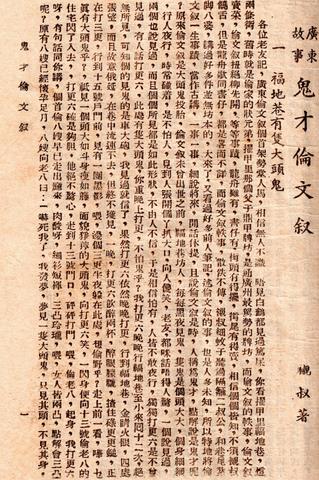
Number One Scholar - Chapter 1 - There's A Big-Headed Ghost in Blessed Earth Lane.

  
Copyright © 2011 - Jeff Loh. All rights reserved


Chapter 1 – There’s A Big-Headed Ghost1 In Blessed Earth Lane.

My dear friends! Canton’s Lun Mun Chui’s prestige and fame is as thick as people and horses crowding into a city. There is no one who does not know him. You may not have seen a white crane but I am sure you must have seen a pile of shit before [This is how well known Lun Mun Chui is in Canton]. In the old days, somewhere between, ‘First Candidates Selection’ and ‘Blessed Earth’ Lane2 was the official residence of the Lun family. The imperial memorial arch of ‘First Candidates Selection’ is the most famous in all of Canton. Everyone knows the apocryphal stories of Lun Mun Chui, how he sold vegetables in his youth and how he bested Lau Sin Hoi3 at his own games, so Uncle Chen4 shall refrain and spare his tongue from wagging too much. One can hear these stories sung in Dragon Boat Songs5 or you can read them in books. However, they are not detailed and many of these apocryphal stories are lost. When Uncle Chen6 was a kid…

I heard many stories from neighbouring second uncle7 and from foot-bound eighth auntie8. Mostly from unofficial sources. I read many writings of the old describing the life of Lun Mun Chui that not many people know. I shall now recount these events in detail as stories. No more idle talk and let me delve right into the topic.

During his lifetime and after, Lun Mun Chui was known for his uncanny wit. Why was he so demon-witted? You ask. Well, this is because he was the reincarnation of a big-headed ghost9. Before he was born, neighours of Blessed Earth Lane had been seeing a ghost every night – one with a big head with a small body. While walking in the night when people came across it, it would simply open its large mouth and grin at them idiotically. It was not afraid of people10. My friends please don’t say it’s not a frightening scene at all! When one person sees it, two more will come forth and claim that they too had seen it. As all descriptions were very similar even skeptics began to wonder if the stories were true. Very soon everyone was afraid to walk outside at night; all except for Night Watcher Six11 who had not witnessed such apparitions.

Some people reasoned that if there was indeed a big-headed ghost in the vicinity, why wouldn’t Night Watcher Six be afraid?

“I beat my gongs each night, going through Blessed Earth Lane back and forth at least twelve times12 never have I witnessed such a thing before,” claimed Night Watcher Six.

“This proves that those claiming that they saw the apparitition they were merely firing off their big cannons13!. I’ll believe when I see it.”

So Night Watcher Six continued with his job, sounding the times for the night. When he reached Blessed Earth Lane, he would open his golden pupils and fiery eyes14 to look around purposefully and even pause for a while before leaving the area. Still he did not find anything strange.

One night, after having two cups of wine, his eyes became blurry; beating on his bamboo plaque and copper gong15 as he went about his business on the third watch. Just when he came to house number fifteen he saw a black shadow.

“Oi! Who’s out there! This late in the night; must be some thief at work.”

Quickly Night Watcher Six went for a closer look. Wah! What a big-headed ghost it was! Head as big as a keg, a skinny vine-like body and a hideous face to match. It stared at Night Watcher Six and gave its signature idiotic grin when it suddenly dodged into house number thirteen where Old Lun Eight lived. Now Night Watcher Six was really courageous and was not a bit least frightened. Quickly he ran up to house thirteen and banged on the door shouting,

“Old Eight Lun! Wake up! I need to talk to you! I’m Night Watcher Six.”

Mrs. Lun Eight was already walking out of the hall. So ugly she looked in her undergarments with her three delicates bouncing up and down! Hey! Wait a minute! Women have two protrusions. How come there are three on her? Well, that is because Auntie Eight was in her full eighth month of pregnancy. Mrs. Eight said to her husband,

“I was almost frightened to death. I had a dream. In it was this big-headed ghost. I could see its head but not its body. It approached me and with a twist, it pierced into my belly through the trousers leg. At once I struggled and woke myself up. Now the little piggy16 is causing me some pain.”

Oh my! This is getting strange. Night Watcher Six began to wonder about everything he had seen and heard. But before her story ended, Mrs. Lun started experiencing great pains in her stomach.

Notes:

Monday, April 11, 2011

Edited by the Jimbo

1. In Cantonese a big-headed ghost is slang for a rich man or boss by the virtue of his wealth.

2. At Sea Pearl in Canton, there is still a street named ’First Scholar Selection’. The character ‘擢' means to select or to promote. ’甲' means first. In imperial times, it also meant to be first in the imperial exams. According to one story, there were indeed a few Number One Scholars that came from this innocuous looking lane, including Ming Dynasty’s demon-witted Lun Mun Chui. During the Southern Sung Dynasty, there lived a Mr. Wong, a carpenter who came to Canton for work. He had two sons, the elder named Pun and the younger Hei. However the father worked so hard he died of exhaustion before he could see his sons grow up. As the family was poor, the older brother worked and self-studied. In the meantime, he supported and enrolled the younger brother in a private school studio. A few years later the older brother succeeded in the preliminary examinations and became a scholar and the number one scholar at the finals. The younger brother also passed the exams and became the next number one scholar. With two number one scholars coming from the same family, it had a great impact on Canton. Local officials erected a new residence for them and named the street “First Scholar Selection”.

Another story describes this place where Lun Mun Chui was born. Most importantly not only did this place produce the Number One Scholar (狀元); of his two sons, the elder one became the Number Three Scholar (探花) during the reign of Emperor Cheng Te and nine years later, his younger son became the Number Two Scholar (榜眼). Hence the place was named the “Blessed Earth”.

http://hi.baidu.com/hejianfei1227/blog/item/1b4b71097bdfeccf3ac7633c.html
http://www.luns123.com/redirect.php?tid=1068&goto=lastpost
http://zh-yue.wikipedia.org/wiki/%E9%BE%8D%E8%88%9F%E6%AD%8C

3. Arch-nemesis of our hero. We shall encounter him later.

4. See preface.

5. A kind of song popular in Canton. It has nothing to do with the Dragon Boat race or the festival. The street singer carries a small “dragon boat” with a gong and drum going through the neighbourhood to sell his vocal talents. For more details see the video explanation at

http://www.youtube.com/watch?v=OjPqQuEEB60

6. Chinese love to speak in the 3rd person. This is to show one’s humility.

7. In Cantonese slang, the second younger brother of one’s father is a pawnbroker. Because of his profession, he is said to be very experienced and knowledgeable, knowing minutiae that others may not know.

8. Auntie Eight is a derogatory euphemism for a gossipy or fearsome crone. In adding the phrase bound foot (the ancient fetish of Chinese males binding their womenfolk’s feet) implies that she is really old since foot binding was no longer practised during the time of the author (but one could still see such remnants of the old dynasty). The practice was finally stopped by the communist regime. Various reigns of the Ch’ing Dynasty had tried to stamp out this barbaric practice but to no avail since later emperors themselves succumbed to this fetish.

9. In Cantonese slang, a big-headed ghost is a rich person. Because of his wealth he is often the boss or chief.

10. In popular belief, ghosts are supposed to be afraid of the living. This comes from the adage, 人怕鬼三分, 鬼怕人七分. Man is afraid of ghosts by 30% while ghosts are afraid of human being by 70%. Thus an upright person has no fear of them; only guilty ones have.
A nightwatchman.  The character means to patrol

11. A number that is commonly affixed to night watchers. Most probably he is son number six. In illiterate classes, names usually consist of a number or an animal. Cantonese love to affix numbers to nicknames. For example, some came from the design of Chinese dominoes to describe people with certain physical characteristics, ‘tambourine six’ (拎冧六), ‘big-headed six’ (大頭六) or ‘long legged 7’ (高脚七) for the 6th and 7th son.

12. The night is divided into 6 divisions of time. Each division is about 2 hours.
Cantonese slang for exaggerated lies. Reincarnated from the phrase “扯大奅”. “gossiping about great flimsiness”. For detailed explanation see


http://v.youku.com/v_show/id_XMTIwMDE3OTg0.html

14. Description for the eyes of the “Monkey King” who had eaten the peaches of immortality gulped the entire stock of divine wine and swallowed the entire batch of Lao Tzu’s pills making his body indestructible. When he was finally caught he was imprisoned in Lao Tzu’s pill-making furnace in hopes of distilling the essence out of his body so that his mortal remains could be burnt to ashes. However Monkey being afraid of fire moved himself into the wind sector of the furnace where there is no fire. However there was smoke that made his pupils glow in gold and caused his eyes to become fiery, enabling him to see things happening at thousands of miles away. Thus the term now means “sharp eyed”.

15. The watchman would clap on the hollow bamboo stick twice before striking the copper gong twice, with sounds of “duk duk chang chang”. The hour is indicated by the number of beats.

16. Cantonese call their sons little piggy 猪仔as a term of affection because pigs are precious commodities in the old days. Also amongst the illiterate classes it was common to give their sons names or nick names like亞狗 (dog), 亞羊 (goat). Girls on the other hand may not even possess a name!


Original Text


一 福地巷有隻大頭鬼

各位老友記, 廣東倫文叙個首架勢1堂人馬, 相信無人不識. 唔2見白鶴都見過篤3屎, 你看擢甲里福地巷, 這兩條街, 舊時就係4倫家的狀元第, 擢甲里哪5個子鼎甲牌坊, 是通廣州最架勢的牌坊, 而倫文敘的軼事, 倫文敘賣菜, 倫文敘扭6絕柳先開, 等等事跡, 龍舟雖有, 書仔7有, 街頭都有得擺, 街尾有得買, 相信個個皆知, ,不須襯叔饒舌, 但是龍舟歌同書仔, 都是畧而不詳, 而倫文敘軼事, 散佚不傳, 襯叔細蚊仔聽過隔籬二叔公8, 和巷尾紮脚八婆9, 講過好多件並無坊本的, 大來了, 又看過好多前人筆記, 述倫文敍的事, 也是人多未知, 所以特地將倫文敘一生事蹟, 當作古講, 一事一事, 細說將來, 閒話休提, 且說倫文敘是時, 人稱為鬼才, 點解說是鬼才呢10? 原來倫文敍是大頭鬼投胎, 倫文敘未曾出世之前, 福地巷坊人, 每晚黑夜見鬼, 隻鬼是個頭大大, 個身細細, 行人夜行, 時常碰着, 是不怕人, 見到人張開個丫扒大口, 向人儍笑, 老友, 都咪11話唔得人驚, 一個說見過, 兩個也說見過, 而且個個所見都是如此形狀, 不由人不信, 于是相信怕有, 人皆不敢夜行, 獨獨打更六是不曾見過, 有人話打更六, 此處有隻大頭鬼, 你重晚上打更, 不怕鬼乎? 我打更六晚晚行福地巷至小來回十二次, 絕無所見, 可知個的見鬼的是車大砲12, 我見過就信了, 果然打更六依然晚晚打更, 行到福地巷, 金精火眼, 四處張望, 而且故意俄廷, 在巷中流連不去, 但終不獲見, 一晚, 打更六飲醉两杯, 醉眼矇矓, 揸住碌更更鎚, 正在打三更, 打到十五號戶門前, 見一團黑影, 喂, 邊13個三更半夜躲在此處, 想偷野14乎? 走15上前一看, 嘩, 乜16真有隻大頭鬼乎? 祇見一個頭大如斗身瘦如藤, 面貌猙獰的大頭鬼, 向打更六笑, 一閃身便向十三號倫老八的住宅閃了入去, 打更六確是够大胆, 他絕不驚心, 走到十三號門口, 砰砰打門, 喂, 倫老八, 起身, 我打更六呀, 有句話同你講, 個首倫八嫂早已走出廳來, 肉酸17呀, 細衫短褲, 三凸玲龍, 喂, 女人皆有兩凸, 點解18有三凸呢? 原有八嫂已經懷孕足八月, 八嫂向老八曰: “一嚇死我了, 我發夢, 夢見一隻大頭鬼, 只見其頭, 不見其身, 一走走到我身傍, 一攢19到, 由褲脚攢到了肚子裡, 當堂紥醒, 如今個猪20小還隱隱作痛也.” 打更六一聽, 咦, 古怪, 因說所見, 誰不知話說未完, 八嫂繼續肚痛.

   
Cantonese Terms

1. Prestigious, famous, big shot or ‘cool’.

2. Equivalent to 不.

3. Counting word for a pile.

4. Equivalent to 是.

5. Same as 那, just the tones are different.

6. Extending the meaning of ‘to twist’. 扭計 is ‘to twist the plan’ meaning to kick up a fuss or to play a prank. 扭擰 is ‘to twist and turn’ i.e. to be wishy washy or indecisive.

7. same as 子.

8. See Note #6.

9. See Note #7.

10. A final particle,

      a. questioning emphasis: 點知呢? how do you know?!

      b. Reflecting the question back to the questioner: 事情有誰不知呢? for this matter isn’t there anyone who doesn’t know?

      c. To emphasize the accuracy of the statement: 佢地都要求我呢 they must seek my help!

      d. Indicating continuous tense: 現在學習呢 at this moment they are still learning.

      e. Pause indicator functioning like a comma, 現在呢事不同往日 Now, things is not the same as before.

      f. This or that as in, 呢個, this time, that time, 呢陣.

11. Same as 不 don’t.

12. See Note #13.

13. Where 邊處, who 邊個.

14. A thing or an object.

15. The ancient (classical) meaning of走which Cantonese retain means ‘to run’. The meaning in modern standard Chinese is ‘to walk’. Cantonese walk is 行.

16. What. 乜嘢 or乜野 means ‘what things’. 做乜野’ means ‘what are you doing?’

17. So ugly or hideous that one’s flesh turns sour (i.e. to become pickled by frightening to death).

18. Why點解, how點樣, how do you know, 點知 (short for 點樣知道), how do you say點講 (short for 點樣講).

19. Same as 鑽 to piece or drill into.

20. See note #16.

Tuesday, April 19, 2011

Number 1 Scholar - Opening Poem - Marrying A Faggot

  
Copyright © 2011 - Jeff Loh. All rights reserved

Poem of Lun Mun Chui

I submit to bad luck that my life is incomplete,
Everyone is laughing at the idiot me.
No destiny, no beauty would want me,
A sky ladder to the Three Legged Toad Palace1 there is.
The ocean is wide enough for dragons to transform,
Mountains are high enough to listen for songs of Phoenixes,
O when one day when the osmanthus2 reaches Heaven,
Even Chang-O3 will be destined for Ruan and Ji4.

Notes:

The meaning of the poem is quite clear, I am ugly and no one wants a nobody but one day when I became powerful, even the most beautiful girl will marry a faggot! See Note 4.

1. It is believed that the three legged toad of great fortune resides on the moon.

2.  Osmanthus is euphemism for achieving success in the imperial exams.

3. Chang-O (嫦娥) was the beautiful wife of Hou I (后羿) the divine archer who shot down 9 of the 10 suns (in the form of crows) that appeared simultaneously in the sky to prevent the earth from burning up. In gratitude the people made him king. Later at Mt. Kung Lun he met the Queen Mother of the Western Paradise (西王母) who gave him pills of immortality. There are two versions of what happened next. One version is that he became a tyrant and Chang-O stole the pills to prevent him from becoming an immortal and the other is that Chang-O was curious and stole the pills for herself. Whatever the case is she was discovered and downed the pills. She became lighter and fled away to the moon while Hou I shot arrows at her in one version; or in another version, she was filled with much remorse for her action and lived in the Great Cold Palace (廣寒宫) in the moon with a rabbit pounding elixir under an osmanthus (桂) tree.

4. Ruan and Ji are 2 of the seven members known collectively as the Seven Sages or Seven Intellects of the Bamboo forest. They forsook their lives as officials to get away from the officialdom of corruption. Xi Kang (嵇康) was especially close to Ruan Ji (阮籍); their relationship was described as "stronger than metal and fragrant as orchids". The wife of Shan Tao(山濤 , another member of the group) was said to be impressed by the prowess of Ruan Ji and Xi Kang that she spied on them during sex - Homosexuality and Civilization by Louis Crompton

Thursday, April 07, 2011


Original text

倫文敍詩

運蹇時乖命不齊,
人人笑我蠢東西,
眼前紅粉無緣份,
天上蟾宮有步梯
海闊任由龍變化,
山高空聽鳳凰啼,
他朝丹桂高攀日,
自有嫦娥配阮稽

落街冇錢買麵包 – Warning To Lazy Youngsters.

  
Copyright © 2011 - Jeff Loh. All rights reserved

This classic Cantonese song was sung by an actor comedian of the 60s, Mr. Chen Guan Mein鄭君綿. Also he makes a very believable Charlie Chaplin lookalike. This melody was used in the famous Cantonese opera, “An Emperor’s Flower” aka “Princess Flower”. However this time, the lyrics are not of lovers’ lament but a warning to parents and lazy children the consequences of not studying hard, not listening to their elders and fritting their lives away as a gambler to seek shortcuts in life.

I had heard this song during my childhood days. All I remembered was the first line of the lyrics. Now thanks to the internet I have the entire lyrics which I now translate for the enjoyment of my non-Cantonese and to Cantonese friends a walk down the memory lane.

Monday, April 18, 2011

http://www.youtube.com/watch?v=fCpVG2eq9Jg

落街1冇錢買麵包,
Walking down to the street nary a cent to buy a loaf bread,

靠賒我又怕被人鬧.
I want to rely on credit but I’m afraid I’ll get scolded.

肚飢似隻餓貓,
A raging famine in my stomach, like a hungry cat2,

受了飢寒我聞聲喊,
In hunger and cold I started to cry,

皆因肚中飢餓,
All because of the famine in my stomach,

我裡面似係戰鼓敲.
My insides are rumbling like war drums.

最衰平日結交埋一班損友任性來胡鬧,
This worst is that I associate daily with a bunch of louts and mischief makers.

亞爹勸極我完全唔3授教.
Daddy tried his best to warn me but I never listened.

皆因懶,
Because I’m lazy,

趕出校.
I was thrown out of school.

我既頭毛電到以花棚,
My hair was permed until it was like a trellis4,

整得週身衰格扮到唔似男人貌.
Making my looks no longer those of a man.

錢一多週身咬,
Once there is money, my body itches,

總之係猛洗5.
In short I just have to spend like mad.

若冇錢嗰陣6,
When I no longer have any money left,

返家中即刻抄7,
The moment I reached home, I’d search,

搵衫當,
Looking for clothes to pawn,

拎氈8賣.
Sell my blankets.

更糾黨惹事去打交9,
Entangling with gangs I’d look for a fight.

更好尊車大砲10.
Even better is my specialty to brag and lie.

平素學到品質撈咁攪11,
Usually I learnt bad things until my character is in a mess,

我信用已失.
Gone is my trustworthiness.

又怕我難容在世,
I’m afraid I’m no longer tolerated in this world,

必要自少應當管教.
Discipline must and should be taught when one is young.

奉勸人人萬大要關防,
I sincerely advise everyone seriously to take measures,

免使子女學我咁胡鬧.
So that your children will be no nonsense unlike me.

Notes:

Foot notes on the Chinese character are Cantonese terms whereas those on the English are my commentaries.

1. 去街 means to go out. 落街 although means to go out but hints that the person going out lives in a high rise, government built or otherwise. Cities like Hong Kong and Singapore where land space is scarce, most people live in high rises. Therefore when one says 去街, most probably means that person lives in a low storied place. 冇 is the Cantonese version of無 meaning don’t have. Notice how logical the Cantonese character is formed. To have is written as 有!

2. In the eyes of the Cantonese, nothing is hungrier than a stray cat.

3. 唔 Cantonese equivalent to 不

4. Again the lyrics hints of the period when it was fashionable for men to perm their hair to achieve the Elvis Presley look.

5. 洗 means to wash also but in slang it means to spend as in洗錢–washing money.

6. 嗰 means that, then depending on the next character. 嗰陣 that moment, ie then. 嗰個 means that one whereas 個個 means every.

7. 抄 means to copy and the tone is wrong. The character 找 means to search is pronounced like ‘炒 to fry. Maybe there is no character that sounds like chaau(?). (I don’t know the jyuping system).

8. 氈 is blanket but 地氈 floor blanket is carpet.

9. slang for fighting not for intercourse.

10. 車大砲 – carry or drive a cannon – to bluff, to lie, to deceive with a connotation of exaggeration.

11. 撈咁攪 – to scoop and stir at the same time – a mess.

Monday, April 18, 2011

An Emperor's Flower


Copyright © 2011 - Jeff Loh. All rights reserved

An Emperor’s Flower (aka Princess Flower) 帝女花


倚殿陰森奇樹雙 In the shade of the forest by the palace yielded two wondrous trees.

明珠萬顆映花黃 Flowers looked pale against a myriad of shining pearls1.
如此斷腸花燭夜 Such tragedy this wedding night is going to be,
不須侍女伴身旁 Need no maid in attendance.

These are the poetic lines leading to a tragic scene in one of the most famous Cantonese operas. This story takes place at the fall of the Ming Dynasty. Princess Eternal Peace had been betrothed to a young scholar official for a few days just before the peasant revolt of Li Ji Cheng (李自成) broke out and the palace was overrun. Before the last Ming Emperor committed suicide by hanging himself at Coal Hill, he killed off his family with sword in hand. However, the Princess survived her wounds and was rescued. She became a nun but was later discovered by her betrothed in a chance meeting at a nunnery. In the meantime, the revolt had been crushed by the Manchus who had established the Ch’ing Dynasty. In order to pacify the people and lay legitimate claims to the mandate of Heaven, the Ch’ing Emperor was eager to adopt the former princess as his own. The Princess insisted that the Ch’ing Emperor acquiesce to three conditions before she agreed to become his adopted daughter – that he must order the imperial funeral rites to be performed that were due her late father, free her imprisoned twelve-year-old brother, and be able to retain her formal attire of the previous dynasty.

The Princess further stipulated that on her wedding night, the ceremony was to be held in the imperial gardens. There the lovers took poison to escape servitude to the new regime. Like all Chinese tragic love stories, the lovers are depicted as immortals banished from Heaven for violating the heavenly law of falling in love, i.e. having carnal desires2.

The following is the translation of the Cantonese lyrics set to a popular folk song that was sung at the ill-fated wedding night scene. This is just a story loosely based on historical events. In actuality, Mukden was still the capital of the Manchus. The founding Emperor did not enter Peking. His son, the Emperor Shun Chih was 7 or 8 years when he sat on the dragon throne of China and not a middle-aged ruler as depicted in the opera. The lyrics in blue are to be sung by the Princess Consort, those in black by Princess Eternal Peace and in red to be sung together. My next translation project is a set of alternate lyrics for this popular Cantonese. It is a warning to those who do not study hard that their future is nothing short of poverty and squalor.


落花滿天蔽月光,

Falling flowers obscuring the moonlight,

借一杯附薦鳳臺上,
Let a cup be the respects paid on the Phoenix Terrace.

帝女花帶淚上香,
In tears, the Princess Flower burns some incense,

願喪生回謝爹娘
Take my life as thanks to my parents.

偷偷看,偷偷望,
Stealing a glance here, a furtive look there,

佢帶淚帶淚暗悲傷
I see his tears burdened in hidden sorrow.

我半帶驚惶,
Half in fright,

怕駙馬惜鸞鳳配,
I’m afraid that the Princess Consort would linger over the Phoenix match,

不甘殉愛伴我 臨泉壤。
Yearning for the physical love and abandon our journey to the Yellow Springs3.

寸心盼望能同合葬,
Every inch of my heart longs for us to be buried together,

鴛鴦侶相偎傍,
Mandarin duck lovers embracing in each other’s arms.

泉台上再設新房,
Let us rebuild our wedding room in Hade’s Terrace,

地府陰司裡再覓那平陽門巷。
There we can look for that bright lane of no upheaval once more.

唉惜花者甘殉葬,
Alas the flower lover is willing to be buried with me.

花燭夜難為駙馬飲砒霜。
Difficult it is for the Princess Consort to drink arsenic on this night of flowers and candles4.

江山悲災劫,
Catastrophe had befallen on the empire,

感先帝恩千丈,
In boundless gratitude I give thanks to my late liege.

與妻雙雙叩問帝安。
Kneeling together with my wife, I inquire how His imperial Highness is faring in the underworld5.

唉盼得花燭
Alas, looking forward to the wedding night,

共諧白髮,
Spending a lifetime together till our hair turns white.

誰個願看花燭翻血浪,

But who would want to see wedding candles turning into tears of blood.

唉我誤君累你同埋孽網,
Alas, I caused my lord to be tangled in the same web of sin,

好應盡禮揖花燭深深拜,
Let us fulfill our obligations and respectfully kneel before the flower candles4.

再合卺交杯墓穴作新房,
We shall exchange our cups; The tomb is our bridal chamber,

待千秋歌讚註駙馬在靈牌上。
Future generation shall sing of praises to Princess Consort’s spiritual tablet.

將柳蔭當做芙蓉帳,
The willow shade shall be our hibiscus drapes6

明朝駙馬看新娘。
The Princess Consort of the Ming Dynasty will now take a look at his bride7.

夜半挑燈有心作窺妝。
Deep into the night, give me the excuse of pricking the wick8 for a peek at her.

地老天荒
Till the Earth turns old and Heaven becomes desolate,

情鳳永配痴凰,
But the phoenixes will always be in love.

願與夫婿共拜相交杯舉案。
In willingness, a toast to my husband I shall give, we kowtowed to each other with our cups raised high9

遞過金杯慢嚥輕嘗,
Let us drink slowly with these golden cups,

將砒霜帶淚放落葡萄上。
In tears as we drink these grapes dripped in arsenic.

合歡與君醉夢鄉。
In our midst of joy and drunkenness, let us dream of home.

碰杯共到夜台上。
Clinking our cups together, we shall now set foot on the night terrace.

唉百花冠替代殮妝。
Alas this hundred flower crown shall be my funeral adornment,

駙馬珈墳墓收藏。
Let this Princess Consort be the ornament10 to this tomb.

相擁抱
Let us embrace,

相偎傍。
Let us snuggle.

雙枝有樹透露帝女香。
In the tree a pair of branches will reveal the fragrance of Princess Flower.

帝女花。
Princess Flower

長伴有心郎。
Will always be with her sincere lover.

夫妻死去樹也同模样。
As husband and wife die, the trees will take on their forms11.


Edited by the Jimbo.

NOTES:

1. The shining pearls refer to the crown the Princess is wearing. The brilliance of the jewels made the flowers look pale and yellow.

2. In the movie version of the opera performed by the same actresses, the lyrics of the melody were changed so as to explain the lovers’ tragic fate. He was the golden boy and she was the fairy in charge of scattering flowers. I was able to get hold of the lyrics for the movie’s end.


霧煙腤遮世外天
Mists obscuring the lands beyond this mortal world,

有仙山幻作月台殿.
Immortal abodes mistaken for the Lunar Terrace.

散花仙女再會眾仙,
The flower scattering Fairy once more meet her fellow immortals,

侍駕金鑾復歸原.
Once more in the golden Audience Hall, she returns to her original position serving the Jade Emperor.

3. Yellow springs is a euphemism for Hades. When digging a well, the color of water is yellow at its deepest level. Also known as Nine Springs (九泉) because there are nine levels in Heaven and so on earth there must be nine levels as well. Chinese Hades is below that 9th earth level. In the original text, 泉壤–'spring soil’ was used instead to refer the land of the dead.

4. Night of flowers and candles – the wedding night. A table is prepared for the newly wed couple to feast in their room. A pair of elaborately carved red candles are burning together side-by-side on the table. This is used to symbolize the new life the couple faces and that they both may have the same life span like the candles.

5. 請安 – inquiring about the health of one’s parents or superiors. It is a daily filial ritual in old China. In this case, of course, the father, the Ming Emperor, is dead. However, since they are about to meet in Hades, it is still a compulsory ritual for them.

6. Hibiscus drapes is nothing more than a flowery description of drapes surrounding a Chinese bed which resembles a tiny room in itself.

7. The bride is covered by a red veil and the groom will flick it up to see his bride. A formal ritual that he has accepted her as wife.

8. There are no electric bulbs in the old days! One has to prick the candle wick up to make the room brighter. What is meant here is for him to have a better look at her.

9. During the private moments in the bed chamber, the husband and wife go through a ritual of kowtowing to each other as a sign of mutual respect and finally a toast by exchanging their cups of wine raised high to their eyebrow level to pledge their love and fidelity.

10. 珈 is an ornament in women’s hairpin. So I guess Princess Consort is comparing himself to this kind of ornament to signify that he will never be parted from the hairpin representing Princess Flower.

11. As indicated in the introductory poem that there are two strange trees in the imperial forest.

Original script.

(世顯長平分端拈彩球跪拜天地後,雙雙步出月華宮外,宮娥分邊侍立,長平對景不勝感慨詩白)


(長平詩白) 倚殿陰森奇樹雙。

(世顯詩白)明珠萬顆映花黃。

(長平悲咽詩白)如此斷腸花燭夜。

(世顯詩白)不須侍女伴身旁。 (白)下去。

(宮女白)知道。 (分邊退下)

(長平燒香一炷起小曲粧台秋思唱)落花滿天蔽月光,借一杯附薦鳳臺上,帝女花帶淚上香,願喪 生回謝爹娘,偷偷看,偷偷望,佢帶淚帶淚暗悲傷,我半帶驚惶,怕駙馬惜鸞鳳配,不甘殉愛伴我 臨泉壤。

(世顯接唱)寸心盼望能同合葬,鴛鴦侶相偎傍,泉台上再設新房,地府陰司裡再覓那平陽門巷。

(長平接唱)唉惜花者甘殉葬,花燭夜難為駙馬飲砒霜。

(世顯接唱)江山悲災劫,感先帝恩千丈,與妻雙雙叩問帝安。

(長平接唱)唉盼得花燭共諧白髮,誰個願看花燭翻血浪,唉我誤君累你同埋孽網,好應盡禮揖花 燭深深拜,再合卺交杯墓穴作新房,待千秋歌讚註駙馬在靈牌上。

(與世顯重新交拜花燭後以柳蔭當做牙床,長平自己蓋上面紗介)

(世顯接唱)將柳蔭當做芙蓉帳,明朝駙馬看新娘。 (挑巾介)夜半挑燈有心作窺妝。

(長平接唱)地老天荒情鳳永配痴凰,願與夫婿共拜相交杯舉案。

(世顯接唱)遞過金杯慢嚥輕嘗,將砒霜帶淚放落葡萄上。

(長平接唱)合歡與君醉夢鄉。 (碰杯介)

(世顯接唱)碰杯共到夜台上。

(長平接唱)唉百花冠替代殮妝。 (一飲而盡介)

Preface to Canton's Number One Scholar

  
Copyright © 2011 - Jeff Loh. All rights reserved

Preface

Lun Mun Chui (Lun Wenxu, 倫文敍)

Born during the 3rd year of Ming Emperor Cheng Hua 成化(1467) and died in the 8th year of Emperor Cheng Te 正德(1513), Lun Mun Chui was Canton’s first imperial Number One Scholar. In those days, the South where Canton is situated was considered a barbaric region even though they were brought into the fold of China proper during the Tang period several hundred years earlier. It was also a place to which disgraced officials were exiled. During the 12th year of Ming Emperor Hung Chi 弘治(1499), not only did Lun Mun Chui became first in the imperial exams, he was also selected as the Number One Scholar by the Emperor himself. The story goes that the results of the exams were so hotly contested that the chief examiner had to report the matter to the Emperor for a tie-breaker. Emperor Hung Chi personally witnessed a couplet-forming contest to decide who was to be the top dog.

When chief examiner Liang Chu (梁儲) heard a crow cawing in the nearby imperial gardens, he posed the following head couplet:

“A crow pounces on a twig, the twig snaps, the crow flew away and the twig dropped down.”1

There is no significance in English but just a picturesque setting. However, in the original language this becomes a different creature. In Chinese the crow is pronounced as “ah”, which has the same pronunciation as the word for twig. So the couplet heading becomes,

“An Ah pounces on an ah, the ah snaps, the ah flew away and the ah fell down”.

The other candidate, Lau Sin Hoi whose name means ‘the willow blooms first’ pounced quickly and completed the couplet first,

“The panther passes by a cannon’s mouth, the cannon roars, the panther fled and the cannon roared into the sky”2

The homophones are the words for panther and cannon. The pattern then is,

“The pao passes by a pao’s mouth, the pao roared, the pao fled and the pao roared into the sky”.

Our Number One Scholar-to-be then calmly replied,

“A goose stomps on chrysanthemum’s leaves, the chrysanthemum blossoms sway, the goose flew away and the chrysanthemum blossoms faced the Heaven3".

Similarly the play is on the words for crane and chrysanthemum. On the surface it looked like it was a tie again. The replies from both candidates met the stringent rules of couplet forming. Liu Sin Hoi was bragging to everyone present that no matter how good Lun Mun Chui was, “I, Liu Sin Hoi am the better candidate. My roar will cower him and he will slink away in shame. My fame as the Number One Scholar shall rocket without obstruction into the sky.” A very ambitious and haughty boast indeed. However on closer analysis, his answer was a bit artificial and contrived because the presence of a passing panther suggests wildness. This makes one wonder why a cannon would be guarding in a remote area? Also ludicrous is the notion that panthers would pass close by the cannons when there are human beings so near.

The scenario painted by Lun Mun Chui is more plausible and its hidden meaning nobler without resorting to personal attacks.  Corrupt officials are represented by the goose stomping on the people in this picture. Once they are removed (only the emperor can remove them), people then can rise and pay their love and respect truly to their sovereign. In another words, kissing the Emperor’s ass! The founder of the Ming Dynasty had great distrust and disdain for scholar officials since he had the humble beginnings of a peasant. The post of the prime minister was abolished and the emperor held that position personally. This was because of historical precedents of regicide happened in earlier dynasties.
 
Lun Mun Chui was an irascible rascal in his youth. Many a story was told time and again about his sassiness and trouble making. He was also a child prodigy and quick-witted as a demon. Though born from a poor family, as another story goes, he was able to secure money for his journey to the capital for the imperial examinations from his admirers. Never had the province of Canton ever produced a Number One Scholar and village elders were eager to help him in his enterprise. You see hometown compatriots of the Number One Scholar have bragging rights to build an imperial memorial arch to commemorate the prestigious event. In those days, these arches could only be built with imperial permission for such a special occasion and for commemorating great acts of virtuous widowhood, etc.

The full title of the book is “A Cantonese Story Demon Witted Lun Mun Chui”, a 1949 publication containing a set of 5 thin books. Unfortunately book 4 is missing from my collection. With luck perhaps I can obtain the contents of the missing book before this translation is finished. The book was written in a three style manner with semi-classical, standard vernacular and Cantonese colloquial style known as三及. Other variations of the title include, “The Complete Tales of Lun Mun Chui” 倫文敍全傳/集.

Lastly a note on the pseudonym of the author, Uncle Chen (襯叔). Uncle is an euphemism for an elderly gentleman hence 'Old Chen'. For astute Cantonese readers, 'old Chen’ (老襯) is Cantonese slang for 'sucker'. For those interested in reading the original text, I have included in the Notes section a set of explanations of the Cantonese terms used in the chapter. I hope this story, then, will also serve as a Cantonese lesson. Since I could not find anelectronic version on the internet, and character recognition software is as good as automatic translation, I decided to transcribe the original text manually. That way I was able to detect errors and make corrections easily. These corrections will appear in parenthesis in a different color or font, alongside the original text that I concluded was erroneous. Enclosed in square parenthesis i.e. [] is my translation not included in the original text to make things clearer without disrupting the flow of reading. This is a translation project for the entertainment of my non-Cantonese friends. It is greatly appreciated if any error found is brought to my attention.

Jeff Loh

Edited by the Jimbo
Thursday, April 07, 2011, Los Angeles, California, USA

Notes:

The surname Lun () means “normal human relationships” between the sovereign and subject, father and son etc.  Mun () means language, culture, civilization etc, and Chui () means “to narrate” or “discourse”.  Lun is also a homophone for meaning “to discuss”, “to debate”.  So his name can mean “discussion on literary and human relationships”.  The Five Bonds are, “Sovereign and Subject”, “Father and Son”, “Older and Younger Brothers ”, “Husband and Wife” and “Among Friends”.

1. 鴉撲丫枝, 丫折鴉飛丫落地

2. 豹經砲口, 炮響豹走炮沖天

3. 鵠立菊葉, 菊垂鵠去菊朝天. Other variations include 鵠掠穀穗,谷垂秸去谷朝天 – A goose plunders millet sprays, the valley swayed under the weight of grass, when the grasses are gone the valley faces heaven. The homophones are for the words ‘goose’, ‘millet’ (grains), ‘valley’ and ‘grass’. However I don’t think this version is correct because it violates couplet-forming rules because the head couplet plays only on the sounds of two different characters. A 鵠 can also mean a crane or a swan. I chose to translate it in this context as ‘goose’ because chrysanthemums and wild birds did not usually appear together in a natural setting of farming communes in ancient China.