一尺鱸魚新釣得,And when a foot long perch newly baited,
Thursday, June 28, 2018
淮上漁者 Fisherman on River Huai
白頭波上白頭翁,Upon the white crested waves, a
white-crested wizened fellow,
家逐船移浦浦風。Home is where his boat brings him by
the soughing wind.
一尺鱸魚新釣得,And when a foot long perch newly baited,
兒孫吹火荻花中。His offspring and theirs upon dried reeds blew; fire sparks grew; like miscanthus plumes flew.
浦 means bank. However, 浦浦 here
is an onomatopoeia of the wind sound. In
some versions, the first 浦 is replaced by 江
(river). Then the translation would be, Home is the bank where the wind brings his
boat to.
Do you know how difficult it is to burn the even dried feathery
blooms of the miscanthus? So I reject
the notion of the family trying to use these dried reed flowers as fuel.
Friday, January 26, 2018
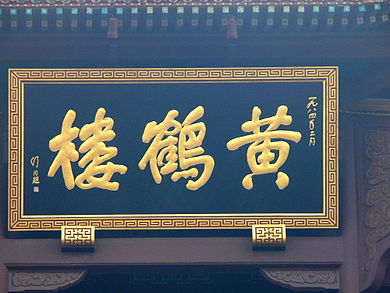
黄鶴樓 The Yellow Crane Tower
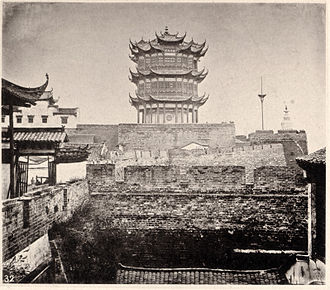
The Yellow Crane Tower was a magnificent tower built in 223 A.D. It
was destroyed a number of times throughout history due to fires and wars. The last rebuilt was in 1868 but was
completely burnt down sixteen years later.
In 1981, it was rebuilt with modern materials about half a mile away
from the original site due to the original location being used by one trestle
of the Wuhan Yangtze River Bridge. The
modern Tower was completed in 1985.
![]() |
| 1871 |
Legend has it that the tower was built as a gratitude to the
wealth made by a small wine tavern. One
day, a Taoist priest came begging for wine.
The owner ignored him but the son was kind and gave him some for
free. For half a year, it was thus. On the last day, the priest told the lad that
as gratitude for his kindness, he would paint a yellow crane on the wall. Each time, the picture was clapped at by the
son, the crane will fly down and dance for all to see before returning to the
wall. In later times, there were other
stories that mortals would ride on cranes and flew away to become immortals.
![]() |
| Present Day |
The fame of this tower was due to an eighth century poem by Cui Hao (崔顥),
昔人已乘黃鶴去, Bygone days of those on yellow cranes riding away,
此地空餘黃鶴樓. 'Tis lonely place -- the Yellow Crane Tower that remains.
黃鶴一去不復返, Once the cranes are gone, never do they return,
白雲千載空悠悠. A thousand years, white clouds float in aimless unhurriedness.
晴川歷歷漢陽樹,The River is bright with each Hanyang tree in vivid reflection,
芳草萋萋鸚鵡州.With fragrant grasses of Parrot Island grow in luxuriance.
日暮鄉關何處是, The sun is setting and which road leads to hometown,
煙波江上使人愁 The mist on the River helps not, but in sorrow for one.

Each floor of the modern tower is themed differently. The top most floor is for scenic viewing of the surrounding areas.
The next one down is reserved for visiting poets of renown. The general public is allowed to view the inside desks, calligraphy accoutrements, etc from the outside.
On the second floor is a marble slab on which is written the characters of "The story of the Yellow Crane Tower" (黄鶴樓記). Here the stories about the rise and fall of the tower through the ages, various poems about the Tower by famous poets along with famous personage associated with the place are displayed on the walls.
On the ground floor is the "White Clouds Yellow Crane" (白雲黄鶴 ) mythological theme. The depiction is made from ceramic tiles. On the pillars bear the following couplet,
Westerly refreshing gusts cometh, the clouds and mists sweeping away regrets of Heaven and Earth.
煙波江上使人愁 The mist on the River helps not, but in sorrow for one.
Each floor of the modern tower is themed differently. The top most floor is for scenic viewing of the surrounding areas.
The next one down is reserved for visiting poets of renown. The general public is allowed to view the inside desks, calligraphy accoutrements, etc from the outside.
On the second floor is a marble slab on which is written the characters of "The story of the Yellow Crane Tower" (黄鶴樓記). Here the stories about the rise and fall of the tower through the ages, various poems about the Tower by famous poets along with famous personage associated with the place are displayed on the walls.
On the ground floor is the "White Clouds Yellow Crane" (白雲黄鶴 ) mythological theme. The depiction is made from ceramic tiles. On the pillars bear the following couplet,
爽氣西來雲霧掃開天地憾
大江東去波濤洗淨古今愁
Easterly the Mighty River floweth, its ripples and waves purifying sorrows of the past and present.
Finally from my paltry learning, this poem was inspired by the catchy title song of Leisure Wanderings (逍遙遊 ) from the series, The Eastern Journey (東遊記) which tells the stories of the Eight Immortals (八仙 ) and their adventures. One story in it was how Lu Dong Bing (呂洞賓) attains his immortality by riding on a crane at this Tower.
https://www.youtube.com/watch?v=g4iG8movPNI
白雲萬世逍遙遊
White clouds had been wandering
without care for eternity,
黄鶴千杯醉閑求
At the Yellow Crane, a thousand cups
is where I seek in drunken leisure.
青天乘風樓空去
On winds I rode into the blue sky and
the Tower is now alone.
紅塵仙界別何有
To the red dust of the mundane world;
to the immortal realm, a farewell bid?
There are two interpretations depending on the meaning of the last line. 别 can mean "to part" or "difference". If the first meaning is taken, then the one riding the wind is an immortal and though he may be leaving but in the future, would return. If "difference" is taken, then "riding the wind" is a euphemism to mean "to die" and so the rhetorical question of "Any difference
between the red dust of the mundane world and the immortal realm?"
Tuesday, January 23, 2018
Royal Palms Beach, Palos Verdes, California.
二月陽光半海銀, February sunshine turning the sea half in silver,
天青寒盡片無雲. The sky is blue and nary is there the cold nor a cloud be seen.
濤擊波鼓催眠醉, Thunderous waves tom-toming into a stupor lull.
鷗叫一驚醒夢人. When a gull's screeching breaks the spell of the entranced.
Wednesday, January 17, 2018
Where Clouds Are Born
雲間生處仙境洞 Where clouds are born, there is a fairy grotto,
千年一瞬烟水夢 A thousand years is like a misty dream of a moment.
I was stuck and knew further progress was not possible. Later at 3am, I was awakened by a dryness in my mouth. After quenching my thirst, I came back to bed but was unable to sleep. My mind's activity was escalating exponentially. In the end, with one character changed, I morphed the first line into,
白雲生處仙境洞 Where white clouds are born, there is a fairy grotto
and use the second line as the concluding one. Completing the second and third lines would now be the task at hand. But before I can do so, "Where white clouds are born", looks like a familiar friend. It did not take me long to realize that it is the second line from Tu Fu's 山行, Mountain Wanderings.
遠上寒山石徑斜 The long stony path is steep and cold is the mountain,
白雲生處有人家 Where there is smoke of white, houses will there be.
停車坐愛楓林晚 My carriage stopped -- by the beauty of the evening maple forest,
霜葉紅於二月花 Even the frosted leaves looked redder than those of apricot blooms.
Let me digress for a moment for some footnotes...
1. Because of the rhyming rules, the Mandarin pronunciation of 斜 (xié) is pronounced as xiá to match that of 家 and 花.
2. In some versions, 生 in the second line is replaced by 深 (deep). However, in my opinion, this makes no sense. The mountain is steep. It would be extremely inconvenient to have a horse carriage drawn up there. At the same time, once in the mountain, how could the splendor of the maple forest be viewed most effectively? I am sure that the poet was not in the mountain but at a distance away. He was describing the scenery from this vantage point. He saw white plumes of smoke rising and hence deduced that there are human dwellings. Poetic licence is taken here. In some interpretations, the poet was said to be visiting his friends. It would be very callous of him; being a high official to break his engagement. There is no cell phone back then!
3. At the first glance, the third can be translated as "stopping the carriage and sit down to 'love' (enjoy) the maple forest in the evening. Has anyone ever see anyone standing in a carriage even for a short drive! If one consults a dictionary, there are many meanings to 坐. As a preposition, it means 'because'.
4. To translate 二月花 as 'February blooms' is misleading since the Gregorian calendar is not used until Imperial Rule has ended. "Blooms of the second month" is acceptable but I find it more poetic to use the flower representation of month instead. Apricot flowers are often orange in color but tinged in pink. So it makes sense that even frosted red maples leaves would look redder.
Now back to my poem...
Since my first line is borrowed from the classics, I might as well do the same for the second line, or at least in some variation. What would be poetic enough to match "white clouds" and fits into the scheme of things? All I could think of, is the first line of Li Shan-yin's Sui Palace, 紫泉宮殿烟鎖霞. Mists enshrouding the Palace of the Purple Spring and obscuring the evening clouds,. Later did I found out from further research that the 'purple spring' is a place where immortals quench their thirst.
I was tossing left and right in bed, racking my brains to come up with something for the third line to tie everything together. Finally, I had the answer. Two nights ago, I watched a Japanese classic, Kwaidan (怪談) on a Blu-ray. It was not the content of the movie that inspired me but by the ethnicity of the movie. It popped the tale of Urashima Taro into my mind...
A young fisherman saved a turtle and out of gratitude, it took the fisherman to the Dragon Palace under the sea where he was entertained and eventually married to the Princess. After sometime, he grew homesick and wanted to return home. The princess entreated him to stay, but of no avail. Finally she gave him a box, telling him never to open if he ever wanted to return. Upon his arrival, he found everything in his hometown had changed. The people he knew were all gone. Everyone he saw or talked to was a stranger. In the end, he learnt the truth that three hundred years had gone by, or in some versions, 33 generations had passed. As there is nothing there for him be nostalgic of, he decided to return to the ocean. He called out to the turtle and as he waited, he thought of the forbidden box. Temptation proved too great for him and upon opening it, a purple butterfly flew out. He was immediately turned into an old man and died.
Using a Japanese story is not well suited in a Chinese setting. No fear! I know of a similar Chinese Rip Van Winkle version...
There was a young woodcutter who one day ventured deeply into the woods than he had ever been. There he espied two men playing chess. Being an avid player himself, he put down his axe and bundle. He stood quietly as an observer to the game. After awhile, he noticed that whenever a black chess piece was placed on the chessboard, plants would grow; and flowers would bloom. A white piece placed -- plants would wither and die. The game was long and the moves were unexpected. He learnt much from the game. At last when the game drew to a close, he thanked the gentlemen for letting him observe the game. They in turn thanked him for not disturbing their game. As he was about to leave, the woodcutter noticed that his axe had rusted; the handle rotted away and his bundle nowhere to be seen. Everything was unfamiliar to him when he reached his village. On further inquiry, he found that a hundred years had passed. He had been watching a game of life played out by the God of the Hours and the God of Longevity. Unlike the macabre Japanese version, nothing was said about the physical state of the woodcutter. Perhaps a cautionary tale to warn that time is precious and never be squandered away.
This story perfectly fits into my poem's theme but I have added a twist. The concluding line was also changed because "a thousand years" is too much an exaggeration. To spare my readers from the boredom of my polishing the poem, here's the result.
白雲生處野仙踪 Where white clouds are born, will there be traces of wild faeries,
清泉紫流烟鎖紅 The Purple Spring flows pure in misty red.
若見二者棋即離 And when upon two at chess espied, depart with all haste,
莫待百年瞬一空 Wait not for a hundred years vanish in a blink of an eye.
Thursday,
January 18, 2018
UPDATE:
It had been seven years since I had revisited this page. During this time my experience increased and technology leapt in great strides. With the proper tools, I was able to polish this idea into a better expression. Here's the latest version...
2 靜流紫泉烟鎖紅 Quietly flows a purple spring veiled in misty red.
3 林中二者棋下迷 In a forest where two lost in a game of chess,
4 今刻莫戀百年空 This very moment! Tarry not! For a hundred years will pass in vain.
3 迷 means “be obsessed with” but “lost” is a preferable translation by meaning.
4 Literally, “this moment, attached not (to the game/place)…”
Saturday, April 19, 2025
Wednesday, December 13, 2017
尋道 - Seeking The Path*
The title can also be translated as Seeking Tao (Immortality).
飛霜雨後雪衣新 New are the white robes after a snowfall,
隱隱古道隔外塵 An ancient path hardly revealing itself to the outside world.
曾經鶴鳴不知處 Once I know not where the cranes are calling
from,
唯獨青松酒伴人 Nevertheless
the green pines are my drinking attendants.
Friday, December 1, 2017
飛霜雨 Rain of Fluttering Frost
As of 01 Dec 2017, I had written fifty-one Chinese poems but mostly not of worth or interesting enough to put online. Also in part due to my laziness and my addiction in playing Throne Rush which I had recently weaned myself from.
This poem was the result of now having more time for myself as I practised my Chinese brush writing.
風過方知秋夜涼
The wind passes that I realized the
cold of the autumn night,
樓空人情更無常
Empty are the towers, such is the
impermanence of relationships.
忽視飛霜雨幾片 Suddenly I espied a few frosty flakes fluttering down,
醉醺紅塵夢一塲 Inebriating and perfuming this
world of mortals to let me dream awhile.
The last two sentences are interesting as the meaning changes
depending on how they are parsed. The
translation above was done by parsing the characters in groups of two-two-three
where 雨 and 夢 are
verbs and treating the third line not as a question. As a question, the translation would be, Suddenly I espied frosty flakes, how many are
fluttering down?
If the lines are parsed as groups of two-three-two, then 雨 and 夢 act
as nouns of the adjective phrase. So we
have 飛霜雨 flying frost rain and 紅塵夢 red dust dream. With this, the third
line grammatically can no longer be a question.
Suddenly
I espied a few flakes from a rain of fluttering frost,
Inebriating
a dream of the mortal world
Friday, December 01, 2017
Monday, December 19, 2016
Updating an Old Friend
I look into the river. I see my reflection standing still in this fast moving world of flowing waters. There are fishes swimming against the current. They move and yet they remain where they are. I wonder if I am a fish in this rat race of the human world. Go with the flow and you will go far. To the river's end and then what? I am tired, worn out byt he abrasion of time. I need but to seek shelter in the quiet pools with no eddy surging round and round.
This was written on a summer's day of 2013. As a translation exercise in semi-classical Chinese,
河中水, 速流而我映仍然留停不動.水界魚族逆流, 只見移動不見進. 疑問在此快度人世間中是我一條魚? 隨水而去當然有成就. 但到了河盡又如何? 疲倦的我, 精力經已被時間靡費.要尋找一個靜池安棲, 沒有旋渦團團轉.
The other day, as I was digitizing all the physical copies of my handwriting that I came across it again. This time, I rewrote it solely from a Chinese viewpoint.
Each line is restricted to four characters. Some minor differences with the original ensure due to different cultural argument forms. Hopefully, my Chinese had improved. Also the style used as new material for my brush writing practice.
流水速速, Waters flowing fast,
去而不復. Going, going but
return not.
影動不去, The reflection
moves but going nowhere,
鼎立如浮. Solidly it stood,
flimsily it looked.
魚族逆水, Fish swimming
upstream,
有移無進. Movements but progress made not.
心中自疑, Self-doubt in my
heart,
我魚實也. A fish that I
must be.
人界逆流, Swimming against
the current in the world of men,
禍從己賜. Catastrophes are
self-given.
順水者往, Those going with
the flow,
前程錦繡. The road ahead, a success.
河終頭盡, At the river's
end,
安焉何用? Of what use is
there then?
精力疲倦, Tired are my
physical and mental prowess,
時光所廢. Crippled by the
passage of time.
覓尋安棲, Safe haven I seek,
靜池無渦. A quiet pond of no eddy.
團轉莫須, Swirls not
required!
瑤池乎耶? Hark! 'tis the Jade pool
of Paradise is it not?
風過漪缺, Ripple not as the
wind passed by,
清風明月. A life of
serenity led.
世外不必, Real paradise need not,
紅塵非惹! Just that the
vulgar world be no longer courted!
Subscribe to:
Posts (Atom)