Search This Blog

Tuesday, March 15, 2016

Classical Chinese Painting Demonstration By A Friend

Today -- a typical Sunday afternoon of Southern California; cloudy but bright though, with occasional beams of sunlight shafting through the clouds. West Hollywood --  Raucous laughter and rounds of merriment overfloweth out onto the streets as we drove by Hamburger Mary's.  Nothing unusual.

We missed our destination.  At Crescent Heights, we made a left turn.  Our first time to Vinadore Studio & Cafe.  We have not been regular WeHo visitors since the night we met up twenty years ago.  Much has changed.  It was a great respite to see this place of tranquility and quietude greeting us as we drove into the parking lot...  Reminding me how the Abbey was once upon a time: a cozy place where meaningful conversations could be carried out over a cup of coffee or a sandwich as lustful eyes gazed into the limpid pools of one's potential trick, mate or whatever...

We came to WeHo from the Long Beach Area to show support for a friend.  He was to demonstrate how traditional Chinese painting is executed.  We were early. We met our friend, the artist, and people we had never seen before.  Pleasantries exchanged and introductions made.  The place was filled with artwork of western painting decorating the walls.  In the forefront were some mounted and framed Chinese artwork adding further elegance to the place.  Another reason, we knew Andre Ting from other social gatherings and also as an artist but not to the extent of his talents.  Today, we are much educated.

The ambience nurtures an air of elegance as wafts of coffee permeate throughout the place. Along with the sight of treats ordered by others tempting our senses to no end.  We were getting hungry but more eager to see Andre demonstrating his talent.

As more had arrived,  it was time to begin.  Andre introduced some rudimentary information on Classical Chinese Painting after he had taken a few moments to clear his mind...  

Andre in comtemplation to clear his mind before demonstrating his talent


The simplicity of his stroke; seemingly a black mark on the paper soon grew fluidly into an elegant curve of an eagle's crest.  Simply amazing.  

Jokes were cracked; surrounding chatter competing with his explanations -- none could take away the steel-like concentration of Andre in maintaining his brushstrokes.

One astute observer remarked that one has to amortize the time spent in training...  True to a certain extent.  But without talent, no matter how much practice there is, a black mark still remains as such.

Without further ado, thanks to modern technology, mere words can do no better justice than these photos of the artist at work.

Someone asked why there is no outline of any sort.


One big difference between Chinese and Western art is that all pre-planning and penciling are done in the mind.  

Only when the artist is ready, will the swift strokes of the hand descend and begin its graceful dance on the paper.  

Practically speaking, the penciling will show up on the paper no matter how much erasing or hiding is done.


Almost done - in less than five minutes!


"Finished" - Almost...

For demonstration purposes, it is considered complete.  In the strictest sense of fulfilling the traditional requirements, it is yet to be.  First, the artist's signature in form of a real seal had to be placed.  Nowadays, signing in English is fine, but loses the Classical Chinese charm.  Finally, an accompanying poem and the date the piece is completed must be present. 

Painting is the child of calligraphy.  In the old days, painting was not taught until the mastery of calligraphy had been achieved.

To many Western art critics, it is considered graffiti in having the many seals of the painting's past owners stamped on it. To the Chinese, not only do they enhance the beauty but a testament to its importance. Many masterpieces were "extended" solely for this purpose.  There are times when the calligraphy is more important than the painting itself! "Study of a Mountain Engraving" (研山銘) is one such example.

Start of another style in eagle drawing.

Chinese paintings are highly symbolic and can be a rebus.  Thus the theme must suit the occassion as a gift, otherwise a heinous social faux pas is unwittingly committed.

For the uninitiated, it is a road laced with landmines.
For example, two butterflies fluttering delicately in the gentle breeze amongst peony tops makes a beautiful subject. However, as a gift to newlyweds; couple in a relationship, etc is highly inappropriate!  A pair of butterflies represent ill-fated lovers from a Chinese Romeo & Juliet story!

Even if are more than two butterflies, it is best to avoid from being misconstrued.

A crouching tiger showing its ferociousness is most appropriate for a military official, a school teaching Kung Fu, and in the modern day, an attorney, a tax accountant or a judge.

For a genteel profession, it is highly ominous as the pronunciation for tiger in Chinese also sounds like the word for hardship!


Demonstration complete but not the entire composition even by Western standards -- the eagle is too lonely.  A finishing touch of a pine tree branch was added to the bottom right to "weigh" down the subject.

However, to the traditionalists, this is not enough.  This will be seen as an eagle flying to nowhere, in other words, no ambition.

The pine tree represents longevity and endurance in the mortal world.  A red sun on the top left shining over distant mountain tops would be very traditional indeed.  The sounds for "red" and "eagle" are similar to that for "hero".  Thus the composition tells the viewer to "leave the vulgarity of the world behind and aspire to the lofty heights of heroism"

The rooster is Andres's final demonstration for the day.  Its proud stance gives a sense of self-assuredness in its strut.  The paper on which it was painted on is of great quality and had to obtained in China as one cannot find it in Los Angeles. If you look closely, the gold flecks in the paper brings out the liveliness of its tail.


This final painting inspired me so much that a classical styled poem was born into my mind. After much revision, I humbly include it here with a  rough translation.

梧桐高枝鳳凰貴,  Noble is the phoenix high on the boughs of the Wutong tree,
地上群立獨我尊.  Of all standing on this earth, I am the most revered.
紅冠一頂朝日召,  With a red cap, the morning sun I summon,
天下萬事就此傳.  Under heaven, all matters henceforth be decreed.

In Chinese mythology, the phoenix is considered to be the queen of birds, thus the empress' imperial insignia. It is said the phoenix will only alight on the boughs of the Firmiana simplex, commonly known as the Chinese parasol tree.

All in all, it was an afternoon very well spent.

14 Mar 2016

Monday, March 7, 2016

Happy Chinese New Year - 2015!


Happy New Year Everyone!


馬快羊冉又一年, 
寒盡梅紅蓋眼前.
不羨白雲青山遠,
醉眼接花度春眠

Quickly goes the Horse! Slowly comes the trotting Ram. Another year arrives.
Winter departs, red blossoms obscure my eyes.
Envy not the distant white clouds and the mountains green,
With drunken eyes, I welcome the flowers in my slumber of spring.

2015

The Three Shadows


An evening walk at the Cabrillo Marina.  The evening air was warm. Then a sudden whim for a selfie...


From this photo, I was inspired in composing the following poem.

空中一月一遍明,  In the sky, one moon, one stretch of brightness,
地上三影三人夢.  On the ground, three shadows, dreams of three.
此時此刻再難聚,  Difficult for this hour, this moment once more repeated,
好比無緣無相逢.  Better than not having this happened at all.

I guess I was being melancholic, so I came up with a tad less pathetic in tone...

空中一月一遍明,  In the sky, one moon, one stretch of brightness,
地上三影三人夢.  On the ground, three shadows, dreams of three.
此時此刻此聚佳, This hour, this moment, this get-together great,
無緣無份無相逢. No fate, no destiny, no rendezvous.

12 Oct 2015

Wednesday, March 2, 2016

後庭花 - Courtyard Flower


細風落葉微飛舞, Gentle breeze, falling leaves; slightly in dance.
高閣芳林昔日豪. High pavilions and fragrant forest; grandeur of old.
一遍黄地花雖有, A stretch of ground in yellow, though grown with flowers,
七尺青絲結綺無. Rapunzel, her Tower of Beauty Forming, no longer around.

The ground looked yellow because of the approaching dusk.  Of course there is no Rapunzel in Chinese.  For more details, see 

http://jeffinous.blogspot.com/2013/06/courtyard-flower-soul-of-chiang-li-hua.html

A Nocturnal Reflection


烏節路名也. 是新加坡大厦酒店購物中心遊客區. 堂煌極奢. 品質高貴, 服務一流. 當然也是食玉炊桂!

烏節幽幽雨早成, Orchard Road is now quiet with the passing rain,
華燈代月引道徑. Bright lights replaced the moon to lead my way.
多年相隔自有異, Many years had passed since, and of course, there will be changes,
懷中前景朝夜明. In my mind, the former scenery is always clear.

I had purposely used 前 to be ambiguous since it can mean "former", "in front" and word play on 明, "bright" or "clear". So the last line can also be interpreted as "In my heart, the scenery in front of my eyes will always be bright". However, due to context in the previous line, this is not the intended meaning. I could have used 舊 (old) to be clearer but I think it is too direct for my taste.

Thursday, August 20, 2015

Another Music Inspiration


I was listening to one of my favorites - The Butterfly Dream Concerto and once more my Muse came for a visit. This the result of one revision. The performer this time is Takako Nishizaki (西崎崇子) on the violin. I just love her crane motif red dress. Such a classic and classy garb.

花間春眠長, By the flowers, a long spring slumber,
人生蝶夢短.Life is but a short dream of the butterfly.
飛燕梅楊去,The flying swallows, the plum blossoms and the poplars are all gone,
水流不斷斷.Only the river is still flowing unceasingly.

Wednesday, August 19, 2015

The Chinese reader might be puzzled by the word order of 梅楊 which usually means the Chinese strawberry (Myrica rubra). Actually, the double meaning in the poem do not refer to their literal meanings. They are the names of three great beauties in Chinese history. I have listed their names in chronological order. "Flying Swallow" is Chao Fei-yen, the Han Dynasty Empress. The "plum blossom" is the official title of a Tang Dynasty concubine because of her love for it. As for the "poplar", it is the last name of the imperial concubine who later replaced the former as the emperor's new favourite. Once they were the number two in the land but in the end were dealt with a tragic end.

Without launching into a lengthy discussion, the butterfly dream in the poem refers to the dream of the philosopher Chuang Tze who was wondering if he had dreamt of himself as a butterfly or that it is the butterfly dreaming of a man.

https://www.youtube.com/watch?v=NXBL6iftZmw

Thursday, August 20, 2015

Friday, April 24, 2015

Metamorphosis of a Poem


Friday, April 17, 2015

Sudden phrases pop into my mind as usual when I am busy with something else. This time it was 飛雪紅梅 (flying snow, red plum blossoms). I had to place it somewhere in a box of my mind for later retrieval. Then as I lay in bed and pondered on
it, my feet were literally getting cold despite being safely tucked underneath the blanket. A theme began to coalesce -- the colder it is, the blossoms will bloom with greater vigor. No wonder the Chinese admire this flower so much. It has the tenacity to not be afraid in the face of adversity. Along with the two other "Friends", the pine tree and the bamboo, it is prominently featured in the traditional arts, whether in paintings or as porcelain-ware motifs.

My idea was about the mores of a frustrated scholar in his preparation to pass the imperial examinations. In today's terms, "study hard and be successful".

飛雪紅梅又一冬     
Fluttering snow and plum flowers blossoming - another winter
十年苦讀功未成/通 Ten years of hard study gone by and still unable to succeed/understand

For a few days, I was stuck. I could not proceed beyond these two lines. I tried to look at the masters for inspiration but no such luck. I just had to let it lie there and languish. Then a few more days later, a friend posted a link on Facebook. It was a video about an interracial marriage between an Australian lady and a Singapore man in the 1960s. The video talked about their love lasting through the decades despite harassment and prejudice in the societies they lived in. https://www.facebook.com/irememberSG?fref=nf

It was the inspiration I was looking for. The first line is so appropriate to their situation. A draft was formed along the lines of,

飛雪紅梅又一冬, flying snow red plum again one winter
流水盡去與夢同. flowing waters completely flow past and dream same
蝶殘花香早已謝, butterfly crippled flower fragrance early already withered

I could not end the poem. The last line eluded me. To put my mind at ease, I continued to read more articles on this couple. April 16th came and I suddenly remembered an old 1930's movie, The Enchanted Cottage,

https://www.youtube.com/watch?v=pKted5j6ZpI

Finally I could cap the poem with the theme of the movie,

心中視覺仍龍鳳 In hearts, still seeing we are the dragon and phoenix.


The "Dragon and Phoenix" is a great metaphor for male prowess and feminine beauty. Now with the structure complete, I could work on the refinements...
First of all, I felt that 飛雪 (flying snow) was not colorful enough. A quick change was easy. 白雪紅梅 (White snow red plum) is bursting in color. However, in the English mind of mine, I was thinking in modern terms that unless it is polluted, the color of snow can only be white. To me, this is redundancy and a waste of words. "Red plum blossoms" is fine since they can take on other colors.

There is plenty of movement in 飛雪橫梅 (flying snow, sideway plum blossoms), colors being hinted at and the imagery is good -- stretched out boughs, laden with blossoms looked as if there were being blown flat by the wind. With more word twiddling,

白雪横飛紅梅冬, The white snow flying across a red plum blossom winter

A good compromise, however, I ran into trouble as the second line is now out of place and the change of scene is too abrupt. "又一冬" (Again another winter) in the first line is the lead-in to the next.

"Flowing waters" denotes the swiftness of time passing. I considered splitting the idea into two lines,

白雪横飛又一冬, White snow flying sideways again another winter passes
紅梅盡放 ? ? 同

The problem now is that I do know how to fill in the places denoted by the question marks. To change the theme or rhyme is something which I did not want. Have to leave this as it is and continue with the rest of the poem. The last line has the idea but the wording is coarse and inelegant. More mulling and I came up with,

彼此彼此仍龍鳳 Each other, with one another, still a dragon and a phoenix.

At first I was quite happy but the repeat of 彼此 bothered me. It hints of exasperation, a mood I do not want to portray. I wanted something happy...

彼此相觀仍龍鳳, In the gaze of one another, still a dragon and phoenix.

Though an improvement, something is still amiss. My present inspirations, like the magic potions in the computer game that I am now playing, were all used up. I just have to wait for another day of renewal...

Thursday, April 23, 2015

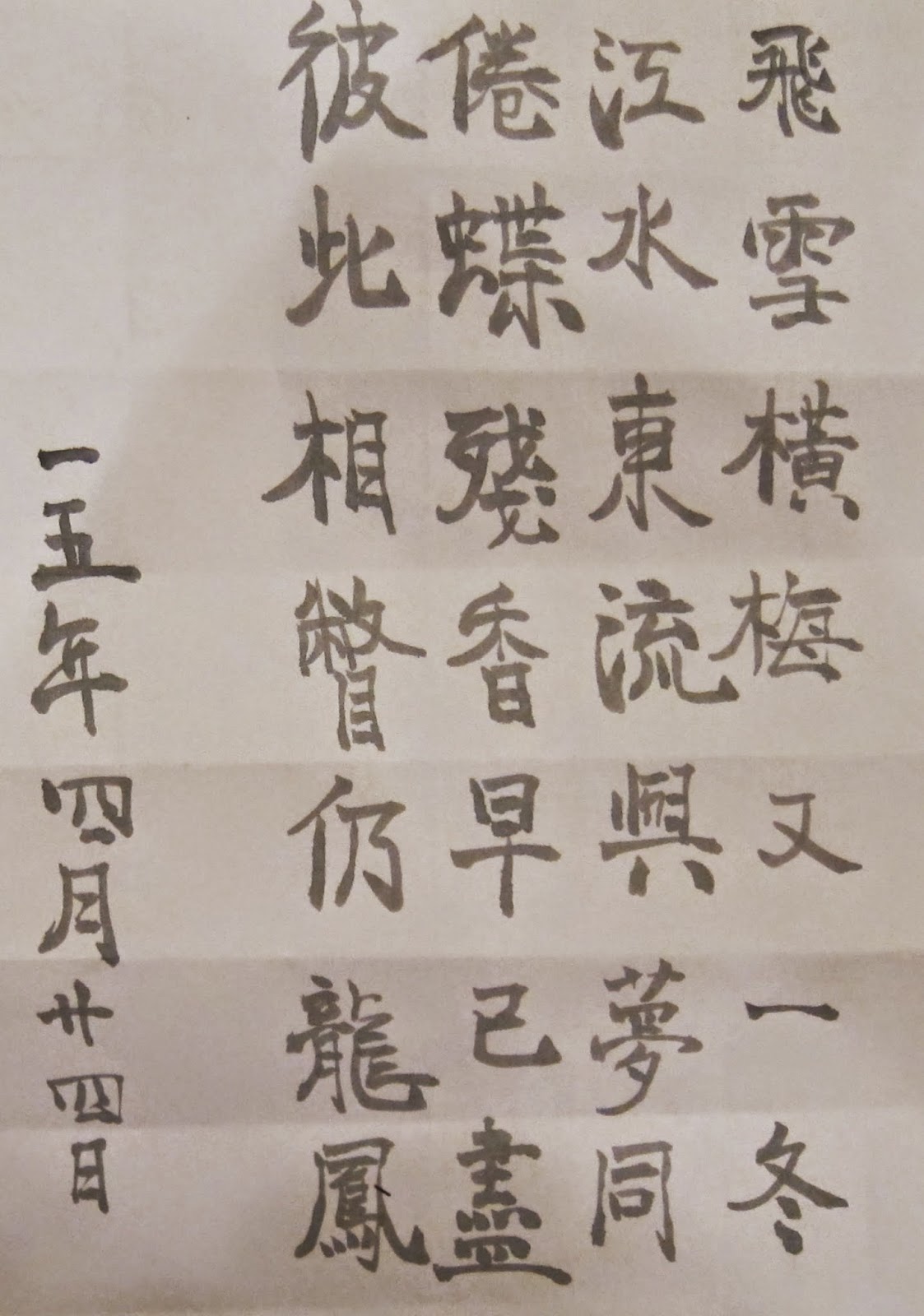
I rewrite my essays over again and again to gain refinement. Unlike typing with versatility on an English keyboard, it is better to kill two birds with a stone by practising my Chinese "calligraphy" with the brush in an old-fashioned manner. Sure enough, as the poem was repeatedly written, like some gene mutation over a time, words began to transform and ideas become more settled. The flow seemed more fluent as the characters were expressed through the ink and brush.

In the end, I decided to forgo the idea of having color in the first line. After all, there's plenty of "colors" through the shades in the black-inked character strokes contrasting with the snow-white underside of the now scrap paper of a now defunct computer printout. Yes, I do recycle.


The first line remained the same while the second became,

江水盡流與夢同. The river waters flow unceasingly like a dream.


盡流 can be interpreted either as the flow had completely stopped or that its flow is carefree with no sign of stopping!

I remembered I had learnt 倦蝶 (tired butterflies) from a Chinese writer in an "italki" essay, which I now will use it to the fullest. Whoever that unknown writer is, one "I thank you".

倦蝶殘香早已逝 tired butterfly crippled/weak fragrance early already passed.

Here 逝 also evokes the imagery of death. Still, the final line lacks the punch I intended. I had considered other characters such as 看, 望 but not 見 (since 相見 means "to meet up"). They did not make the cut. Then I remembered a song from an old classic Chinese movie of the 1960s, 江山美人, The Kingdom and the Beauty starring Lin Dai (林黛).

http://www.56.com/u98/v_NTQwMTgxODM.html

The theme song was in a form of a classical poem,

一瞥驚鴻影, One furtive glance, a startled swan,
相蓬似夢中. Our meeting is like a dream.
廣寒身未到, To the Lunar Palace of the Great Cold not reached yet, (a sexual allusion)
分手太匆匆, Too quickly comes our departure.

Unabashedly, I am lifting 瞥 to convey the full force of the poem's intent of a furtive gaze of an old couple whose love had endured the ages.

飛雪橫梅又一冬, Across laden boughs of plum blossoms, flurry snow yet of another winter,
江水盡流與夢同, The river flows towards its end like a passing dream.
倦蝶殘香早已逝, Tired butterflies and withered fragrance had long since gone,
彼此相瞥仍龍鳳. To each other, a furtive glance exchanged, still a dragon and a phoenix be.

By no means this is the end of the story. As time passes and with more experience and knowledge gained, there may be changes yet to come.

Friday, April 24, 2015

Epilogue

What prophecy! No sooner than what I had written was proofread by someone and posted on my blog, a minor change occurred as I tried to get a better brush writing version. I accidently wrote a wrong word which proved to be a blessing. Instead of writing 流 (flow), I wrote 去 (to go, past). I pondered on this and finally decided that this new change was for the better since there is hint of something long gone. At the same time, there is no need to have extra words in the English translation when there are none in the Chinese version.

江水盡與夢同.

On December 17 & 18, 2022, while practising my Chinese brush writing to see if my handwriting had improved, more changes were made…

飛雪橫梅又一冬, Across laden boughs of plum blossoms, flurry snow yet of another winter,
水流盡去與夢同, 
The river flows towards its end like a passing dream.
倦蝶殘香久已, Tired butterflies and withered fragrance had long since gone,
彼此相瞥仍龍鳳. A furtive glance to each other, still a dragon and a phoenix be.